Travel Nurse Stipends & Tax Homes: 4 Rules You Can’t Afford to Ignore
Mar 07, 2026What You Think You Know About Stipends Might Be Costing You
Travel nursing gives you mobility, flexibility, and income potential most nurses never see. But it also places you inside a tax structure that doesn’t explain itself.
Housing stipends. Meal allowances. Per diems. Extensions.
They sound straightforward — until they’re not.
The difference between tax-free income and taxable income often comes down to whether you understood the rules before you signed the extension.
This isn’t tax advice. It’s clarity.
Because when you understand how the system works, you move differently inside it.
1. The 12-Month Rule: When a “Temporary” Assignment Stops Being Temporary
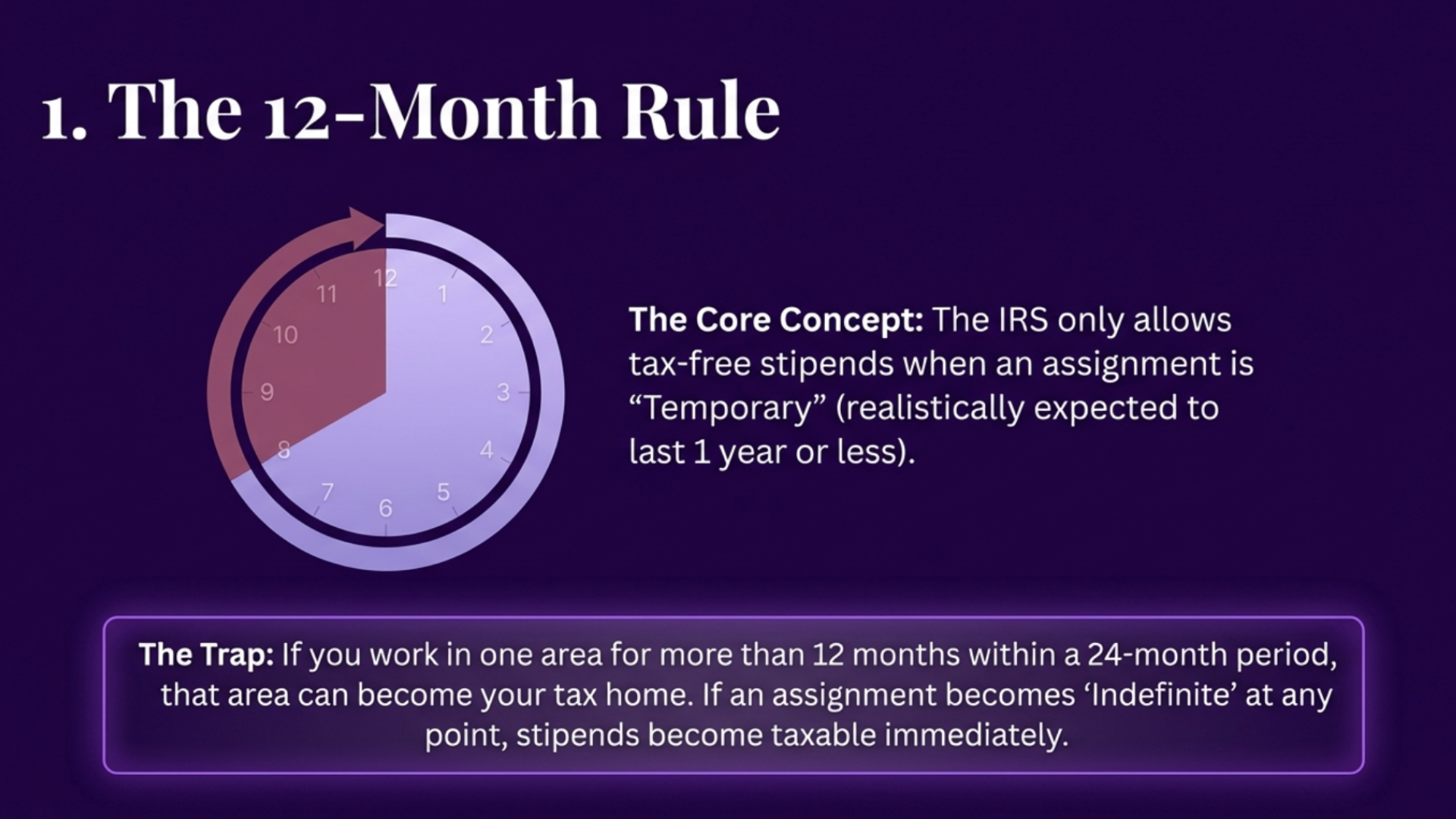
The IRS allows tax-free stipends only when an assignment is temporary.
Temporary means it is realistically expected to last one year or less — and actually does.
Here’s where many travelers lose leverage:
- If you work in the same general area for more than 12 months within a 24-month period, that area can become your tax home.
- If at any point your assignment becomes indefinite (expected to exceed one year), stipends become taxable immediately — not later.
Example:
You accept a 9-month contract in Dallas. You extend for another 4 months. Now you’ve crossed the 12-month threshold. Dallas may be considered your tax home — and those housing and meal stipends may no longer qualify as tax-free.
The issue isn’t the extension.
It’s whether you saw the tax implications before signing it.Tip: Many experienced travelers take strategic breaks before returning to the same area. Not because someone told them to, but because they understand timing changes tax treatment.
That’s awareness. That’s leverage.
2. The “50-Mile Rule” Isn’t a Rule
You’ve probably heard the myth: “You need to work at least 50 miles away from home to get tax-free stipends.” The truth? There’s no strict 50-mile rule.
The IRS uses a “sleep or rest” test instead:
- The assignment must be far enough away that you cannot reasonably return home for adequate rest between shifts.
- If a “local traveler” doesn’t need overnight lodging, housing stipends are usually taxable.

Example: You live in Chicago but pick up a 12-hour weekend shift 25 miles away that still allows you to drive home overnight. Because you don’t need temporary housing, any per diem for lodging would generally be taxable.
3. Can You Use a Parent’s Home as Your Tax Home?
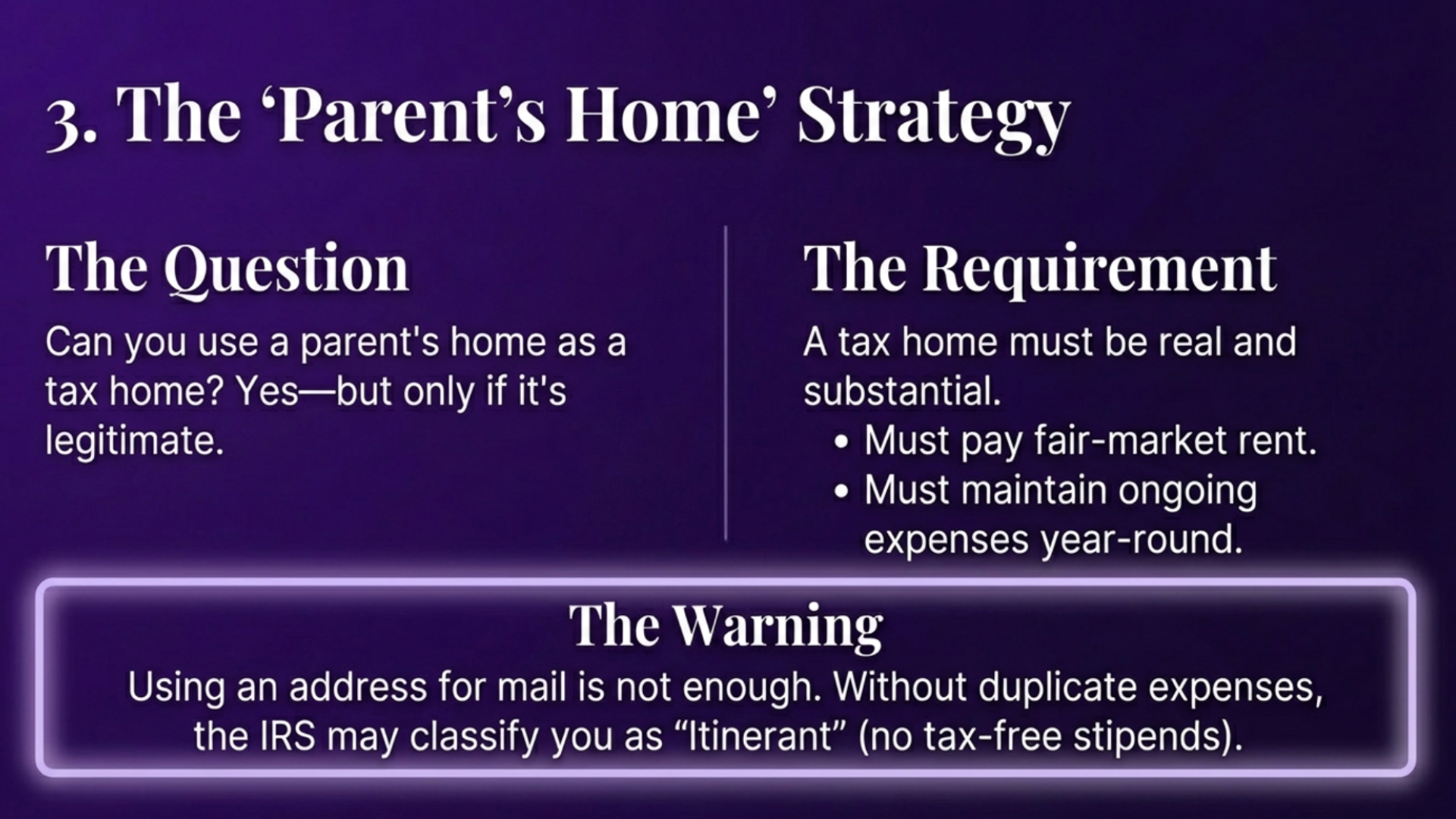
Yes — but only if it’s legitimate. A tax home must exist in a real and substantial way.
That means:
- Paying fair-market rent or contributing meaningfully to housing costs
- Maintaining ongoing expenses year-round
- Being able to prove it with documentation
Using a parent’s address for mail is not the same as maintaining a tax home. If you aren’t duplicating expenses, the IRS may classify you as an itinerant worker. And itinerant workers don’t qualify for tax-free stipends.
Example:
You pay $800/month in rent plus utilities at your parent’s home while renting temporary housing near your assignment. That documentation supports your tax home claim.
Living there for free does not.
The difference is proof.
4. The Three-Factor Test for Determining a Valid Tax Home
If you don’t have a main place of business, the IRS looks at three factors:
- Business Connection: Are you performing part of your work in the area of your main home?
- Duplicate Expenses: Are you paying living costs at your main home that are duplicated while on assignment?
- Historical Ties: Do you maintain ties to the area, like family living there, or using it frequently for lodging?

Example:
You maintain an apartment in Atlanta where your family lives. You pay rent and utilities year-round. You return there between assignments. When you take a 6-month contract in Nashville, Atlanta can reasonably serve as your tax home.
It isn’t about checking one box.
It’s about demonstrating consistency.
What This Really Comes Down To
Travel stipends aren’t about mileage.
They aren’t about what another traveler said worked.
They aren’t about what a recruiter implied.
They’re about structure.
- Know how long you’ve worked in each area.
- Track whether your assignments are still temporary.
- Maintain and document duplicated expenses.
- Keep records. Always.
Most financial mistakes in travel nursing don’t happen because someone broke the rules.
They happen because no one explained how the system actually works.
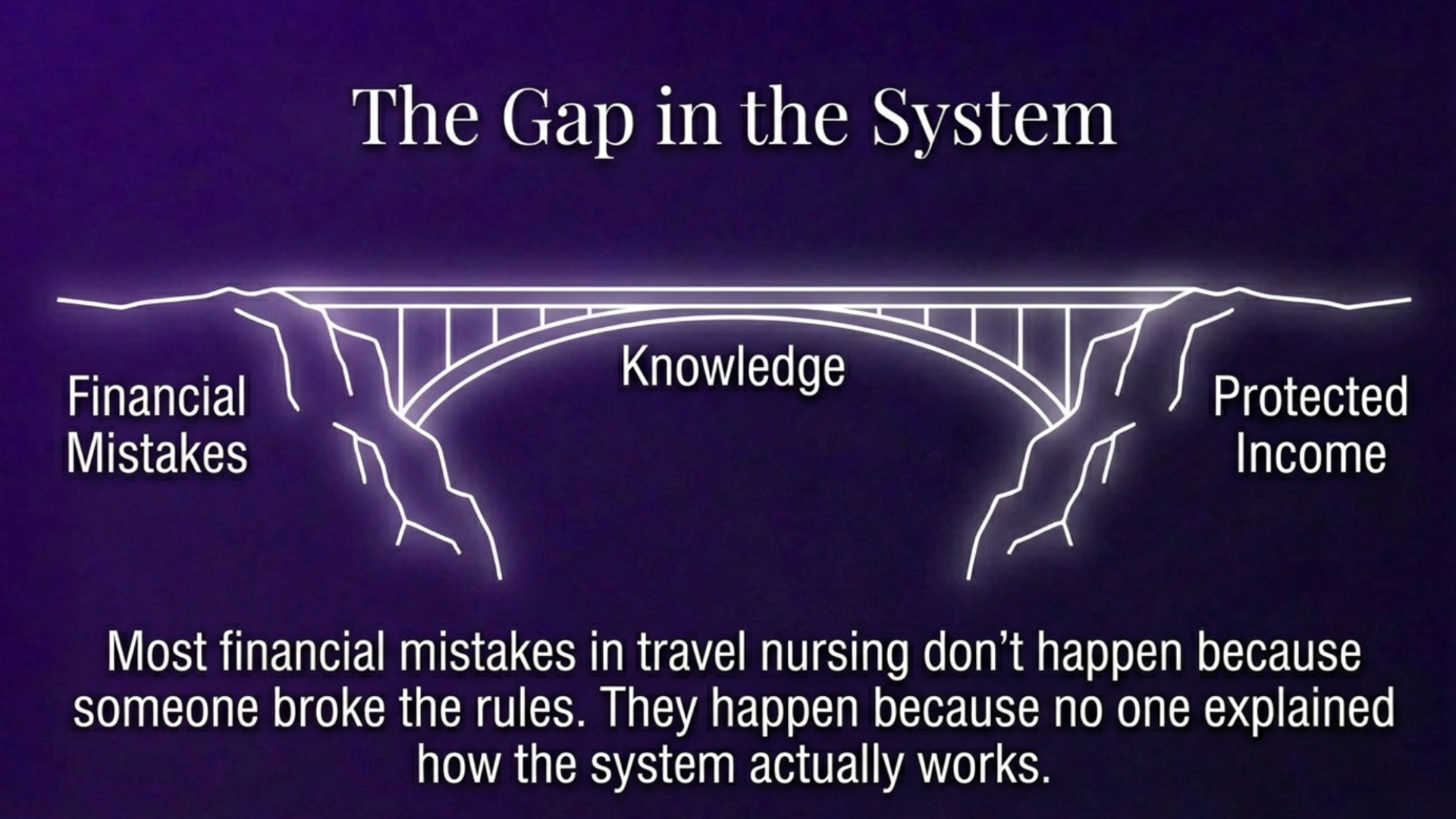
HCTA exists to close that gap. Because when you understand the structure behind your contract, you protect your income — instead of reacting to problems later.
Remember: This is general information, not tax advice. Every travel nurse’s situation is different, so always consult a qualified tax professional before making decisions that could affect your stipends.
If this gave you clarity, imagine what happens when you understand your entire pay structure.
Inside the HCTA Healthcare Traveler Certification, Module 6, Deciphering Pay Structures and Compensation Packages, we break down stipends, taxable vs. non taxable income, bill rates, and how your compensation is actually built.
Because knowing the rules is helpful.
Understanding how to work within them is leverage.
If you’re ready to move through this industry informed, prepared, and positioned well with agencies, the Certification is where that shift happens.
Explore the HCTA Healthcare Traveler Certification, and step into your next contract with confidence.
HCTA can help you navigate the industry with less stress. Check out our self-paced courses to get confident, career-ready, and totally in control of your travel life—without the overwhelm.