The Housing Stipend Paradox: Why Travelers Think It's "Free Money"
May 02, 2026(And What That Assumption Actually Costs Them)
There's this thing that happens when travelers get their first contract offer.
They see the breakdown: taxable hourly rate, then the stipend line. Housing. Meals and incidentals. Big numbers. And somewhere in their brain, a switch flips. *That's extra. That's mine.*
And honestly? The industry kind of wants you to think that way.
Because if you understood what stipends actually are, and what the IRS considers them to be you'd ask a lot more questions before you signed. You'd negotiate differently. You'd structure your expenses differently. And you'd probably feel a lot less celebratory about a "high-stipend package" that's just moving taxable income into a grey zone.
Let me be clear: stipends aren't bad. They're one of the biggest financial advantages of travel healthcare. But they're also one of the most misunderstood parts of this career and that gap between what travelers assume and what's actually true creates real risk.
So let's talk about what housing stipends really are, why the industry stays vague about them, and what it actually takes to keep them compliant and advantageous.
What a Housing Stipend Actually Is (According to the IRS)
Here's the thing most agencies won't lead with: your housing stipend is tax-free reimbursement for duplicate expenses.

Not a bonus. Not extra income. Reimbursement.
The IRS allows it to be untaxed because you're maintaining a permanent residence somewhere else while working temporarily in a new location. You're paying for two places at once. The stipend is meant to offset that.
But here's where it gets tricky.
If you don't actually have those duplicate expenses: if you're not maintaining a tax home, if you gave up your lease, if you're just bouncing from contract to contract with no fixed address then that stipend isn't reimbursement anymore. It's income. Taxable income. And the IRS can (and does) reclassify it during audits.
Most travelers don't know this until it's too late. And most agencies? They're not going to bring it up during the offer call.
Not because they're trying to deceive you. But because tax liability is murky, enforcement is inconsistent, and as long as you're accepting the offer, there's no incentive to complicate the conversation.
So travelers take the stipend. They assume it's theirs to keep. And they structure their whole budget around untaxed income that might not actually qualify as untaxed.
The assumption that the stipend is just free money is what creates the paradox.
Why High-Stipend Packages Aren't Always the Win They Look Like
You've seen the posts. "Just accepted an offer with a $2,400/week housing stipend!"
And everyone celebrates. Because big number = good offer, right?
Not always.
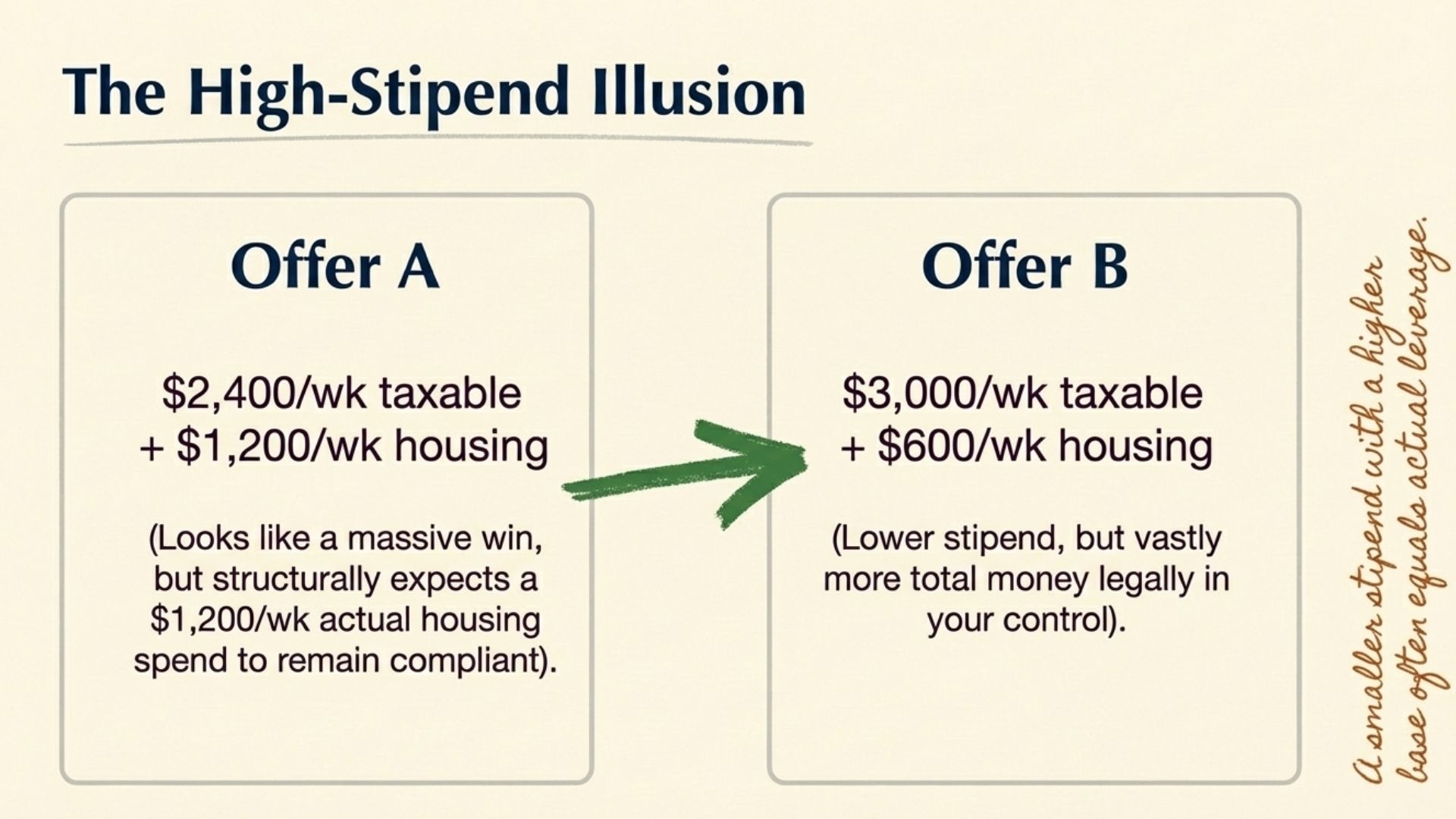
Here's what a lot of travelers don't realize: agencies can structure your pay however they want, as long as the total package hits a certain number. They can shift money from your taxable hourly rate into your stipends. They can make the taxable portion look smaller and the stipend look massive.
And why would they do that?
Because it makes the offer look better. You see $2,400/week housing and you feel like you're winning. But if your taxable rate is $28/hour and the traveler next to you is getting $42/hour taxable with a $1,800 stipend... you might actually be making less when taxes, retirement contributions, and future Social Security benefits are factored in.
High stipends aren't bad. But they're also not inherently better.
What matters is the total compensation, how it's divided, and whether the stipend structure actually matches your real expenses.
If you're spending $1,200/month on housing and your stipend is $2,400/week, that's great, as long as you're compliant. But if you're not maintaining a tax home, or if your actual housing cost is way under that stipend, you're holding untaxed income that could get reclassified.
And that's the part nobody talks about during the offer stage.
What It Actually Takes to Keep Stipends Compliant (And Why That's Not Explained Up Front)
Let's get practical.
To keep your housing stipend tax-free, you need:
- A permanent address (your tax home) that you're maintaining and returning to regularly
- Actual duplicate housing expenses while on assignment
- Documentation that proves both
That means keeping your apartment, paying rent or a mortgage, and being able to show the IRS that you're not just living out of a suitcase full-time.
Some travelers do this easily. They keep a home base. They go back between contracts. Their stipends are legitimate reimbursements.
But a lot of travelers don't. They sublet their apartment. They stay with family between assignments. They go straight from one contract to the next without ever returning to their "tax home."
And in those cases? The stipend stops being reimbursement. It's just income you haven't paid taxes on yet.
The IRS has specific rules about this (the "1-year rule," the "regular return" expectation, the idea that your tax home has to be where you actually live and work when you're not traveling). But agencies don't walk you through this during onboarding. Some mention it in a disclaimer. Some don't mention it at all.
Because the responsibility falls on you. You're an independent contractor (even if you don't think of yourself that way). Your tax situation is your responsibility.
And most travelers don't find this out until they're talking to an accountant three contracts in, realizing they've been structuring everything wrong.
The Smarter Way to Think About Housing Stipends (So They Actually Work for You)
Here's the shift:
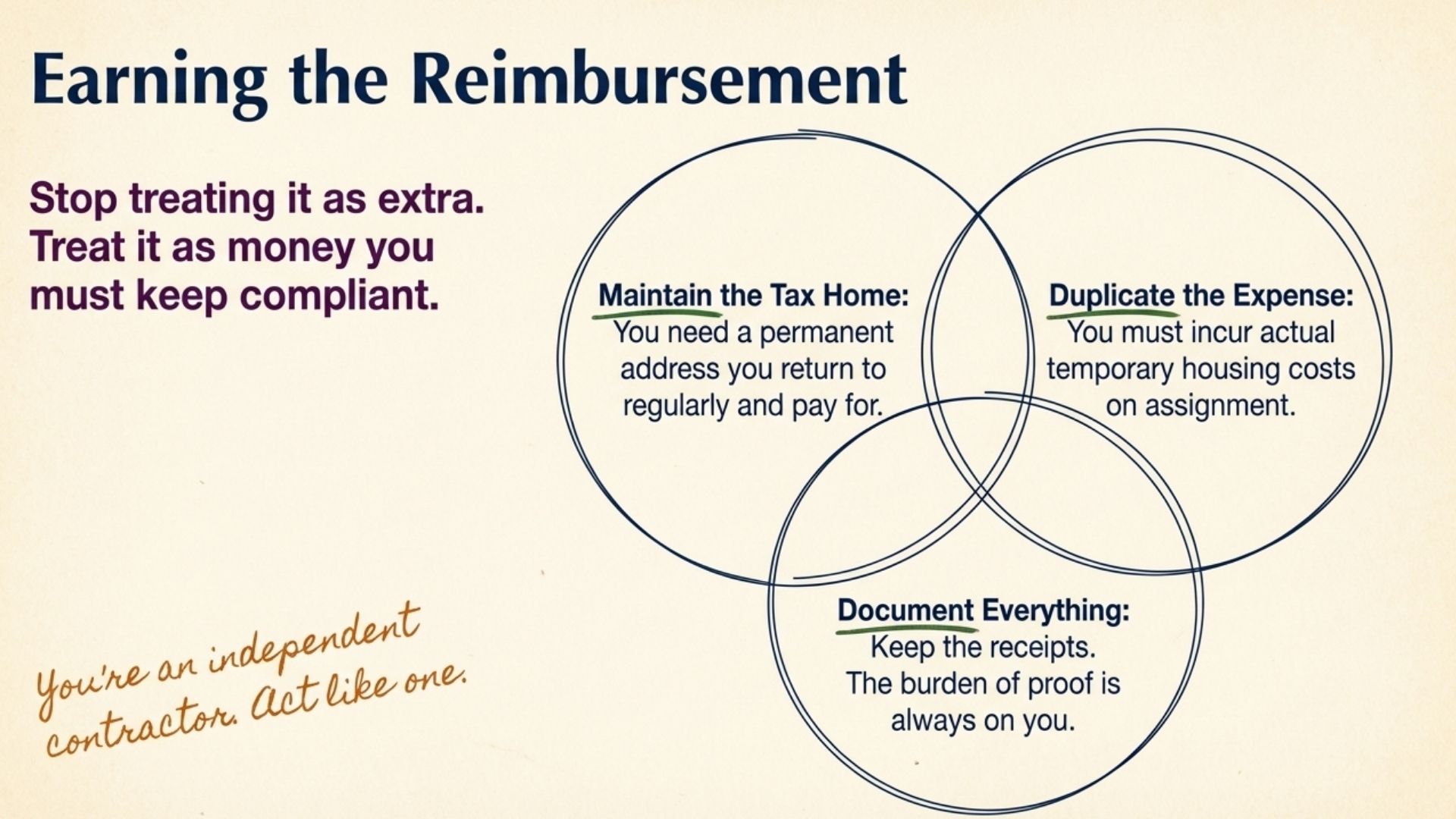
Stop thinking of your stipend as extra money. Start thinking of it as *reimbursement you have to earn by staying compliant*.
That means:
- Keeping a tax home and documenting it
- Tracking your actual housing expenses on assignment
- Comparing stipend offers against your real costs, not just accepting the highest number
- Understanding how your taxable vs non-taxable split affects your long-term financial picture
It also means asking questions during the offer stage that most travelers skip:
"What's the taxable hourly rate vs the stipend breakdown?"
"If I find housing under the stipend amount, can we adjust the split?"
"What documentation do you need from me to keep this compliant?"
Those questions reveal how much the agency actually understands (or cares) about tax compliance. And they shift the conversation from "Wow, big stipend!" to "Does this structure actually work for my situation?"
Because here's the thing: stipends are one of the best parts of travel healthcare. They let you keep more of your income. They give you flexibility. They make this career financially sustainable.
But only if you're using them correctly.
And the industry's not going to teach you that up front. You have to know it before the offer call.
Get clear on how your pay package is actually built — taxable income, stipends, and what it all means for your financial compliance with Mastering Fluctuating Income. It walks through exactly how to evaluate offers, structure your housing expenses, and stay compliant so your stipends work the way they're supposed to.
The best financial advantage isn't the highest stipend. It's the one you actually get to keep.
HCTA can help you navigate the industry with less stress. Check out our self-paced courses to get confident, career-ready, and totally in control of your travel life—without the overwhelm.