Why Some $2,100/Week Travel Nurse Contracts Beat $3,500 Ones
Feb 07, 2026The 2026 Travel Nursing Market Isn’t a Gold Rush Anymore… It’s a Strategy Game
For a while there, travel nursing felt like chaos wrapped in opportunity. Crisis pay (think COVID). Sky-high rates. Contracts flying around like confetti.
But now… things have settled. And honestly? That’s not bad news.
As we move into 2026, travel nursing has officially grown up. It’s no longer a short-term emergency fix for hospitals. It’s a permanent, strategic part of how the U.S. healthcare system runs. Which means the nurses who thrive from here on out aren’t just chasing the biggest weekly number anymore.
They’re thinking in Net Value.
Net Value looks at what actually lands in your bank account and your life after cost of living, taxes, stipends, licensing delays, and long-term resume growth are all factored in. It’s the difference between feeling rich on paper and feeling secure in real life.
So let’s break down what’s really happening out there… and where smart travelers are quietly winning.
Where Demand Is Still Red Hot (And Why)
Demand in 2026 isn’t random. It’s being driven by legislation, population shifts, and hospital expansion… not just “everyone’s short.”
California and the Pacific Northwest
California is still the heavyweight. Mandatory nurse-to-patient ratios mean hospitals legally can’t stretch staff when census spikes. They have to bring in help. That alone keeps demand steady, with a projected shortage of 44,000 nurses by 2030.
High-acuity specialties like ICU, OR, L&D, and Med-Surg stay consistently hot. Weekly pay often lands between $2,500 and $3,500+, especially in places like San Francisco and Los Angeles.
But… licensing takes 8 to 12 weeks, Live Scan fingerprints can require a physical trip, and coastal rent can chew through a paycheck fast.
Washington has quietly become the calmer cousin. Strong NICU and ER demand, solid pay, and no state income tax. Seattle can be pricey, but nurses commuting from Tacoma or Aurora are finding real Net Value here.
The Sunbelt Boom: Texas, Georgia, Florida
Texas is exploding. Population growth. Aging residents. Constant hospital expansion. Some analysts think it may eventually pass California in job volume.
ER, Telemetry, and PCU nurses are in steady demand, with weekly pay averaging $2,000 to $2,800. No state income tax helps your take-home stretch further, especially in cities like San Antonio and El Paso.
Georgia’s growth is centered around Atlanta and rural shortages, with projected nurse job growth of 15.3% through 2032. Florida stays busy year after year thanks to seasonal population spikes, with consistent needs in ICU, Cardiac Step-Down, and Med-Surg… and yes, winter contracts still hit different.
The Northeast: Big Volume, Big Expectations
New York’s demand is intense. Job openings jumped from 304 pre-pandemic to over 7,600 in 2025. NYC runs high-pressure and high-volume, while upstate offers a different pace.
Massachusetts brings teaching-hospital prestige. Weekly pay averages $2,400 to $3,000, but expectations are high. If you want resume muscle, this is where you earn it.
Why the Biggest Paychecks Can Quietly Shrink Your Life
Here’s the part nobody explains early enough.
High demand doesn’t always equal high Net Value.
Let's bring this down to contract reality because nobody’s signing “annual” anything out here.
Here’s what this looks like on a sample 13-week contract once cost of living shows up uninvited:
When cost of living is factored in, the math gets very real:
- California:
A 13-week nominal contract of about $24,952 adjusts down to roughly $17,232… that’s about $7,720 less in real value over one contract. - Hawaii:
Starts around $26,268 for 13 weeks, then drops to about $14,055 after cost of living… a painful $12,213 hit for one assignment. - Michigan:
A 13-week contract around $27,069 actually adjusts up to about $29,446… that’s a +$2,377 gain without working a single extra shift. - Oklahoma:
Same 13-week lens… you’re looking at roughly +$3,895 more in real value once cost of living is factored in. - Texas:
Comes in at about +$1,855 extra per 13-week contract, helped along by no state income tax and lower overall expenses.
And this is the part nobody tells you when they’re hyping “top-paying states…
These differences aren’t abstract. They’re a car paid off. A savings buffer. A few months off between contracts. Or not stressing when something breaks mid-assignment.
Same 13 weeks. Same effort. Very different outcomes.
The Midwest Is Quietly Winning
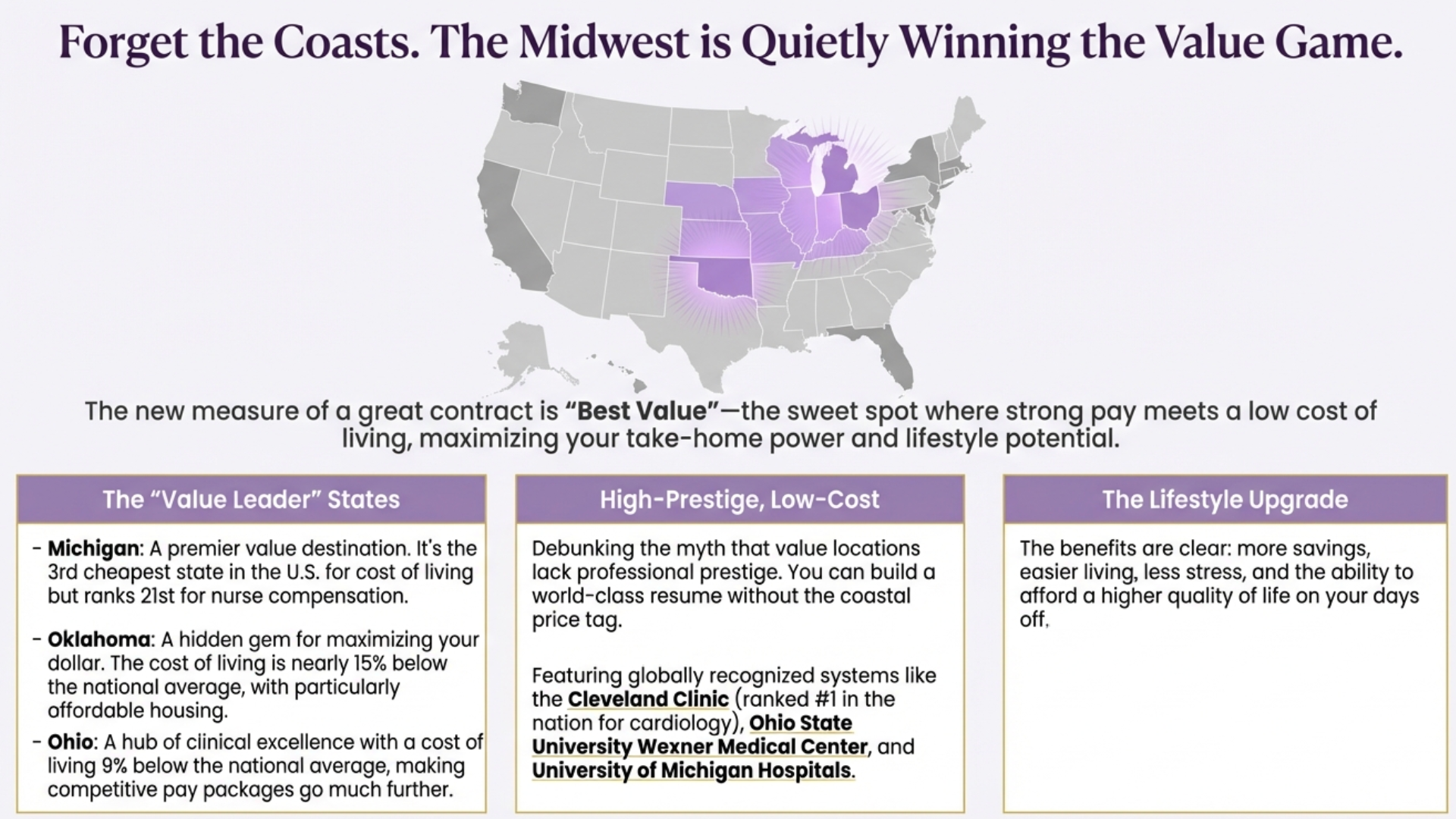
Michigan has become the poster child for Net Value. It’s the 3rd cheapest state for cost of living while ranking 21st for nurse compensation. Housing is accessible. Stipends stretch. Savings actually happen.
Oklahoma ranks as the 5th-cheapest for housing and daily expenses. Indiana offers compact licensing, strong specialty pay, and cities like Indianapolis that feel livable without draining your paycheck.
And then there’s Wisconsin…
Two Rivers and New Lisbon are posting average hourly wages of $65.61 and $61.17. Coastal-level pay… Midwest-level expenses. No influencer cafes required.
Licensing: The Silent Pay Killer
Time off waiting for a license is unpaid time. And it adds up fast.
The Nurse Licensure Compact now covers 43 states and territories, which is huge. One license. Many states. Faster starts.
But non-compact hotspots still come with friction:
- California: 8–12 weeks, Live Scan fingerprints, and fees around $350.
- New York: 6–12 weeks, plus required coursework in infection control and child abuse.
- Michigan: 4–8 weeks, but a temporary license can be issued in as little as 48 hours, valid for 18 months.
A 12-week delay on a $2,800/week contract equals $33,600 in lost income. That’s not a small oops. That’s an entire financial season gone.
California’s Plot Twist
Here’s the nuance most conversations miss.
California costs more. It pays less in real terms. Licensing is a pain.
And yet… mandatory staffing ratios change everything.
Hospitals can’t overload you legally. Demand stays steady. Burnout risk drops. Assignments are often safer.
So for some nurses, California isn’t about maximizing money. It’s about protecting their license, their body, and their nervous system. That trade-off is personal… and valid.
World-Class Resumes Are Being Built in Ohio
If you think elite experience only lives on the coasts, Ohio politely disagrees.
- Cleveland Clinic ranks in 13 specialties and #1 in cardiology. Weekly pay can hit $3,422.
- Ohio State Wexner ranks in 9 specialties, with a lower-than-average cost of living.
- Cincinnati balances specialty pay with a lifestyle that doesn’t require a second job.
You get Tier-1 experience without Tier-1 rent. That’s Net Value with a long-term lens.
The New Winning Strategy for 2026

The nurses thriving right now are playing a multi-state game.
They keep a compact license for flexibility. They hold one or two strategic single-state licenses like California or New York. They invest in high-acuity certifications like CCRN or TCRN. And they’re willing to look past the obvious cities.
Fargo. Des Moines. Asheville. Richmond. Two Rivers.
Not flashy. Very effective.
The market isn’t punishing travelers anymore… but it is rewarding the informed ones.
So the real question isn’t “Where does everyone want to go?”
It’s…
Where does your money, energy, and career grow best next?
And that’s the kind of move we love teaching inside HCTA.
HCTA can help you navigate the industry with less stress. Check out our self-paced courses to get confident, career-ready, and totally in control of your travel life—without the overwhelm.