The Fall Contract Window Nobody Talks About (And Why July Is Already the Move)
Jul 04, 2026The best fall assignments are already being filled.
Not in September. Not even in August. Right now, while most travelers are still in full summer mode. And honestly? That tracks. But the nurses who keep landing the good ones... great location, solid rate, actual room to negotiate? They figured out a long time ago that the hiring cycle starts way earlier than most people think.
Once you see how it works, you can't unsee it.
What Fall Pay Actually Looks Like in 2026
Good. Not crisis-era good, but good.
The market normalized after 2020–2022, and "normalized" doesn't mean low. Most travelers are pulling in $1,800 to $3,200 per week. About 10–20% higher than 2019 pre-pandemic averages. Lower-demand roles land around $1,800 to $2,400. The bulk of assignments across the country sit between $2,400 and $3,000. High-demand specialties and urgent fills are still hitting $3,000 and above.
ICU/critical care, ED, OR, L&D, telemetry are still the blue-chip specialties. Geography matters too. Rural areas, Midwest states, and parts of the South tend to offer stronger overall compensation packages right now.
And don't just look at the weekly rate. Your actual take-home depends on how the taxable hourly and non-taxable stipends are structured. A coastal assignment with a flashy rate can easily net less than a Midwest contract that looks smaller on paper, so always run the real numbers.
Why Hospitals Are Moving Earlier Than Ever
Nobody in September suddenly panics and realizes they need travelers. By then, they're already behind.

The fall pressure is completely predictable with respiratory season, flu surge, elective surgeries ramping back up, new grads still orienting, everyone burning PTO at once. Leadership has been planning for it for months. What changed in 2026 is the stakes got higher.
The Joint Commission's National Patient Safety Goal 12 went into effect January 1st, making nurse staffing a core accreditation requirement. Facilities now have to document staffing adequacy as part of their safety record. Surveyors can pull individual clinician files in real time during a survey.
What does that mean for you, specifically? Facilities are filtering for audit-ready travelers. Current profile, no expiring certs, clean documentation. If your file creates extra work for their credentialing team right before survey season, you become a risk they'd rather skip. If everything is organized and easy to submit, you move to the front of the line. That's not a small thing. That's a direct line between a regulatory change and your contract options. It’s a line most travelers have no idea exists.
Why the Job Boards Aren't the Whole Picture
What you're seeing on your travel app in September is what's left after weeks of behind-the-scenes movement.
Recruiters with strong facility relationships are submitting candidates before jobs ever go public. Those slots fill fast. If you're already in that pipeline, you get first access. If you're not, you're selecting from whatever's left.
The timeline breaks down roughly like this. Late June through July is the first quiet wave — harder-to-fill specialties, less competitive markets, facilities with budget flexibility. Late July through September is peak hiring season when the bulk of openings go public. By October, you're filling gaps and last-minute holes.
Waiting until September isn't a disaster. It just means fewer choices and less room to negotiate.
A lot of travelers hold out thinking rates will climb if they wait. Probably not — and possibly the opposite. That strategy made sense during the crisis era. It's not this market. The desperation premium is mostly gone because facilities are now planning ahead specifically to avoid paying crisis rates. Late-stage openings tend to be available in October not because they pay great, but because the first wave of travelers passed on them for a reason. The real pay advantage is in July, before the competition floods in.
What "Being Ready" Actually Looks Like Right Now
This part is more practical than it sounds.
Update your profile to reflect your most recent assignment. Recruiters submit what's on file, and under NPG 12's documentation requirements, facilities are prioritizing travelers whose files they don't have to chase. Check your certs and licenses. Know what's expiring and when. Then have an honest conversation with your recruiter about what you actually want: location flexibility, shift preference, your minimum rate, preferred contract length. The clearer you are, the easier it is for them to go to bat for you.
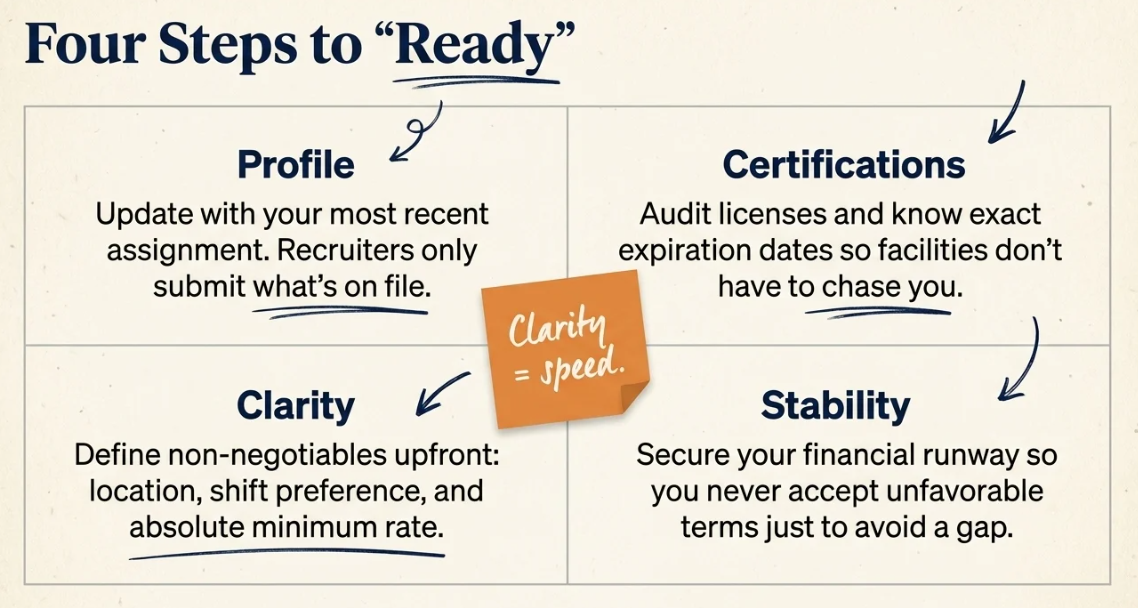
And don't underestimate the financial piece. Negotiating from a place of stability means you don't accept unfavorable terms just to avoid a gap between contracts.
If your current contract doesn't end until September, same advice ~ slightly different timeline. You don't need to be available now to start positioning yourself. Recruiters prefer knowing your availability early because it gives them time to find something good instead of scrambling the week you finish. Update your profile now. Have the conversation now. Get documentation sorted now. You're not behind. You're just working a slightly different part of the same window.
The travelers who struggle are the ones who finish a contract, take a breath, and then start thinking about what's next. By that point, the first wave is already gone.
You're Already in the Right Window
Most travelers are still in summer mode. The ones thinking about fall positioning in July are the ones consistently landing in that first wave — better options, better rates, more room to negotiate.
Fall contracts will still exist in September. But the best ones that have the locations people actually want, the rates worth writing home about? Those go to whoever showed up early.
You already did the hard part by showing up in July. The HCTA Traveler Success Bundle covers the rest... financial runway, contract know-how, recruiter relationships that actually go somewhere. Everything you need to make this window count.
HCTA can help you navigate the industry with less stress. Check out our self-paced courses to get confident, career-ready, and totally in control of your travel life—without the overwhelm.